Metascience project

Paying It Forward

How are research outputs changing in the age of AI?

OverviewA metric for classifying research outputs

AI is accelerating research productivity, particularly in data-rich analysis and automated software generation, potentially shifting incentives away from creating new research resources. Yet there is currently no systematic way to measure how research communities produce, use, or extend essential artefacts such as data and software.

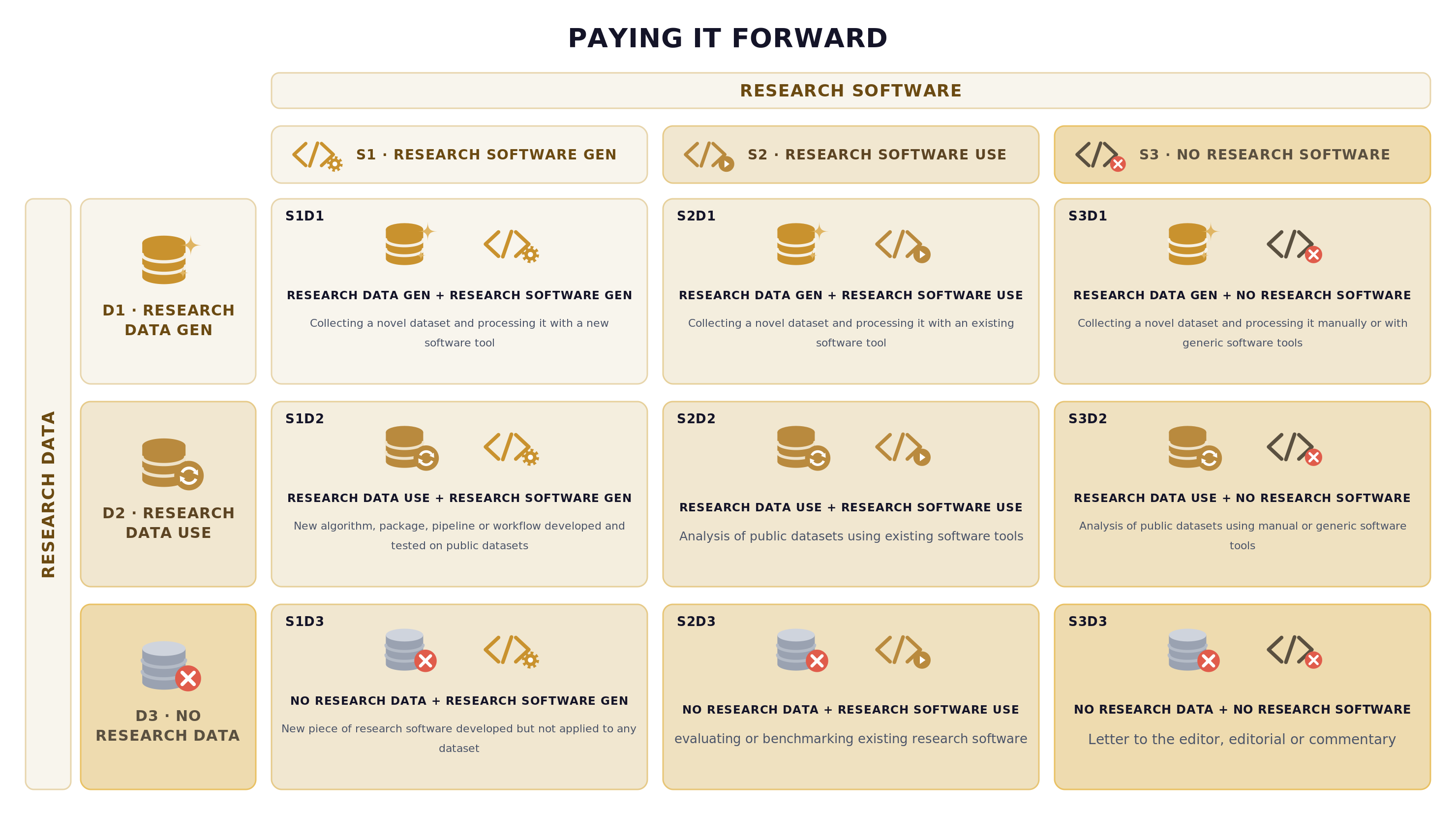
Paying It Forward builds a metric, or set of criteria, that describes whether a piece of research generates new research artefacts, and what kind of artefacts it produces.

We limit the scope to software and data. Arguably, there are many other types of research artefact, such as a new theoretical methodology, hardware or protocols.

Typology of the nine metric outputs, combining software and data categories
Typology of the different metric outputs, depending on the outputs of a research paper. Click to enlarge.

CriteriaHow do we define our categories?

Open each panel for the detail. Every paper gets one rating for software (S1–S3) and one for data (D1–D3).

What do we mean by data, software and “other”?
Definition Typical evidence in a paper
Research Data
“Research data can be defined as ‘recorded factual material commonly retained by and accepted in the scientific community as necessary to validate research findings’. Although the majority of such data is created in digital format, all research data is included in the definition, irrespective of the format in which it is created.” – UKRI, 2026 (source)
A collection of observations or information produced, collected, processed or released by the research.
Dataset, corpus, database, annotations, benchmark data, supplementary data, model weights, lab books
Research Software
“Research Software includes source code files, algorithms, scripts, computational workflows and executables that were created during the research process or for a research purpose. Software Components (e.g. operating systems, libraries, dependencies, packages, scripts, etc.) that are used for research but were not created during or with a clear research intent should be considered software in research and not Research Software.” (10.5281/zenodo.5504015)
An executable computational artefact produced or used as part of the research.
Source code, package, scripts, application, model implementation
Other Research artefacts that are neither data nor software. Hardware, physical materials, protocols, instruments, figures, documentation, experimental designs, or simply no research artefacts produced outside of the paper, such as a literature review
The scale: generated, used, or not relevant
Substantial role: the software or data is materially involved in producing, analysing, validating, or enabling the research results, rather than being used only for incidental, administrative, or routine purposes.

Software

S1

Research Software Generated

New or substantially extended software that plays a substantial role in achieving the research goals, or is itself a research goal. It should not be a utility but rather represent substantial research effort. The paper should describe how the research created or significantly extended research software. Crucially, the software created should generate new knowledge.

S2

Research Software Used

Existing software that plays a substantial role in achieving the research goals, but is not substantially generated or extended by the research team. It should not be a utility but rather represent substantial research effort. The paper should describe how the research uses existing research software, and the software used should generate new knowledge.

S3

No Research Software

Either software is not used, or the software used does not create new knowledge but instead acts as a utility, or does not play a substantial role in achieving the research goals.

Data

D1

Research Data Generated

New or substantially extended data that plays a substantial role in achieving the research goals, or is itself a research goal. The paper should describe how the research created or significantly extended research data. Crucially, the data created should generate new knowledge.

D2

Research Data Used

Existing data that plays a substantial role in achieving the research goals, but is not substantially generated or extended by the research team. The paper should describe how the research used existing research data, and the data used should generate new knowledge.

D3

No Research Data

Either research data is not used, or the data used does not create new knowledge. Data does not play a substantial role in achieving the research goals.

Some general rules

Generated implies used

If a paper both uses and generates software or data, it belongs in the generated category. We assume that anything generated is also used.

When unclear, go higher

If the right category is unclear, err towards the higher number. Generated (1) needs clear evidence that the research produced it; otherwise classify it as used (2).

The paper is the ground truth

If a paper says it generated software or data but gives no way to access it, we still count it as S1 or D1. Future work packages will assess data stewardship and FAIRness.

CategoriesThe nine categories

Software runs down the side, data across the top. Pick a cell to jump to examples of that category.

S1D1Software + Data generatedS1 GeneratedD1 Generated

Hypothetical case studies

A Machine Learning Framework for Detecting Urban Air Pollution

Researchers develop and release a Python software package for training and evaluating pollution-prediction models. They also collect measurements from 50 monitoring stations and create and release a new dataset of air-quality observations.

S1D2Software generated, Data usedS1 GeneratedD2 Used

Hypothetical case studies

A New Algorithm for Identifying Cancer Cells in Microscopy Images

Researchers develop and release a new image-analysis software package. They evaluate it using an existing publicly available microscopy dataset. The dataset is important to the research, but the researchers do not substantially create or extend it.

S1D3Software generated, No dataS1 GeneratedD3 None

Often called a tool paper.

Hypothetical case studies

A Digital Tool for Reconstructing Ancient Musical Scales

Researchers develop and release a software application that allows researchers to reconstruct and compare ancient musical scales from specified theoretical parameters. The software itself is the principal research output, and the study does not generate or analyse a substantive research dataset.

S2D1Software used, Data generatedS2 UsedD1 Generated

Hypothetical case studies

Measuring Bird Populations Using Automated Acoustic Monitoring

Researchers collect audio recordings from forests and create a new annotated dataset of bird calls and species observations. They use an existing acoustic-analysis software package to process the recordings, but do not substantially modify or extend the software or publish it as a research output.

The Effect of Soil Composition on Plant Growth

Researchers conduct a controlled greenhouse experiment measuring plant growth under different soil conditions. Measurements from the experiment form a new dataset that is released with the paper. Data collection and analysis rely on existing laboratory and statistical software, which the researchers do not substantially modify or release.

S2D2Software used, Data usedS2 UsedD2 Used

Hypothetical case studies

Evaluating Climate Change Effects on Crop Yields

Researchers use data-analysis software to analyse an existing agricultural dataset. Both the software and dataset make substantial contributions to the research, but neither is substantially developed or generated by the researchers in this paper.

Genetic and Environmental Risk Factors for Cardiovascular Disease

Researchers analyse genetic, demographic, and health information from participants in an existing biobank. They use established bioinformatics and statistical software to identify associations between genetic variants and cardiovascular outcomes. The biobank data and software are both substantial to the research, but the researchers do not generate a new dataset or develop the software as part of the study.

S2D3Software used, No dataS2 UsedD3 None

This combination is very rare.

Hypothetical case studies

Formal Verification of a Mathematical Proof Using an Existing Proof Assistant

Researchers use an established theorem-proving system to formally verify a mathematical result. The proof assistant is central to the research but is not substantially developed or extended by the researchers.

Real-world examples: Archive of Formal Proofs · Example preprint

S3D1No software, Data generatedS3 NoneD1 Generated

Hypothetical case studies

A Survey of Public Attitudes Towards Renewable Energy

Researchers conduct a survey of 5,000 participants and create and release an anonymised dataset of survey responses. The dataset is a substantial research output. Although general use software like word processors is used, the research does not involve software playing a substantial role in achieving its goals.

Variation in Leaf Morphology Across Coastal Plant Populations

Researchers collect physical specimens from several coastal plant populations and record measurements of leaf size, shape, and structure. These observations form a new dataset that is reported and made available as a research output. Although they record their data in a spreadsheet, software does not play a substantial role in achieving the research goals.

S3D2No software, Data usedS3 NoneD2 Used

Hypothetical case studies

Historical Trends in Global Life Expectancy

Researchers analyse an existing demographic dataset to investigate long-term trends in life expectancy. The dataset is central to the research, but no new or substantially extended dataset is produced. Software does not play a substantial role in achieving the research goals. Although data is stored and plotted in a spreadsheet, this is not deemed as software playing a substantial role.

Reinterpreting Themes in Early Twentieth-Century Poetry

Researchers examine an existing collection of digitised poems to investigate changing representations of nature. The corpus is an important source of evidence, but no new dataset is produced and software does not play a substantial role in the research.

S3D3No software, No dataS3 NoneD3 None

Hypothetical case studies

A Conceptual Framework for Understanding Scientific Collaboration

Researchers develop a theoretical framework explaining how collaboration influences scientific discovery, drawing on existing literature and conceptual reasoning. Neither software nor data plays a substantial role in achieving the research goals.

Literature review of global warming

A review of existing work that produces no research artefacts outside of the paper itself.

Position or opinion paper, or theoretical algorithm

Argument or theory is the contribution; no software or data plays a substantial role.

Experimental protocol (e.g. for medical trials)

Details of an experimental procedure published before any investigation is carried out. The protocol sets out what data will be collected and what software will be written to analyse the data, but neither are contributed in this paper.
EvaluationHow do we evaluate this metric?

This metric can be evaluated by taking a research paper and using the criteria to give it a classification (e.g. S2D3). For scalability, we are testing whether large language models, both local and frontier models, can classify papers into these categories reliably, and how their judgements compare with human classifications. Once we have established a reliable method, we can apply it to a larger dataset to gain insights into the current state of research output.

TeamWho we are

Typology of the nine metric outputs, full size